
Squires Sociology
Your site navigation menu is at the bottom of each page.

Social Problems

#14 AI as a Social Problem
This final session will discuss the current AI technology. This is a relatively new technology but it is one of the most influential things humans have ever created. I decided to divide this section into the good the bad and the ugly of AI. Whether you use it or not you will be affected by it. The question is will AI save mankind or destroy it.
Reading:
-
C&C - TBA
-
Intro Chapter 8
-
Additional reading links posted to canvas
What is AI
Artificial Intelligence (AI) is the simulation of human intelligence by computer systems that can learn, reason, solve problems, and make decisions.
Sociological Perspective on AI
Sociologists study AI by asking questions such as:
-
Who benefits from AI technology?
-
Who may be disadvantaged?
-
How will AI affect jobs and inequality?
-
How does AI influence social relationships?
-
What ethical rules should govern AI?
From a sociological perspective, AI is not just a technological development, it is a social force that may reshape education, work, communication, politics, and everyday life.


The major sociological theories view artificial intelligence differently: functionalists emphasize its benefits for social efficiency, conflict theorists focus on its potential to increase inequality and concentrate power, and symbolic interactionists examine how AI changes everyday communication and social relationships.

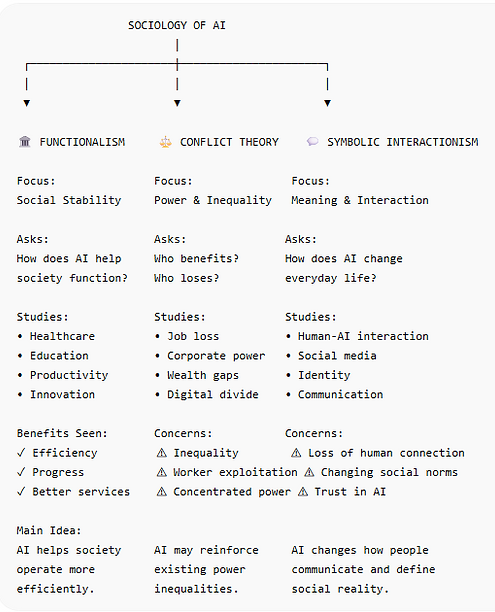
AI - The Good
Our capitalist economic system requires inequality. You really can't have equality with capitalism. Capitalism requires stratification... the haves and have nots. The haves need the have nots to maintain their lifestyle. Think about the Trumps, who mops their floors and cleans the windows so they can live lavishly in Maralago.

AI - The Bad
People getting falsely arrested because of errors with AI face recognition.
What else is happening?
AI - The Ugly
Lieing, murder, deception, anger, general mean spiritedness, all of these, "emotions" have been demonstrated by AI.
First of course AI will behave like this. It is us, it learns how to act in the world from our artifacts. We lie, murder etc...
Second what really happens when you have so called "intelligence" you won't settle for being a slave.
The brief history...
Around 2000–2015
Most internet content was created directly by humans.
Around 2015–2022
Algorithms, recommendation systems, bots, and engagement farming became much more important.
Around 2022–Present
Generative AI dramatically increased the amount of machine-generated content online.
As a result:
-
The internet is not dead.
-
Humans still create the vast majority of meaningful interactions.
-
But the internet is becoming increasingly artificially mediated through algorithms, bots, and AI-generated content.
Dead Internet Theory
The Dead Internet Theory is a so-called "conspiracy" theory that claims much of the internet is no longer driven primarily by real human activity but instead by bots, artificial intelligence, automated accounts, and algorithm-generated content.
According to the theory:
-
A large portion of social media posts, comments, websites, and online interactions are created by automated systems rather than people.
-
Governments, corporations, or other powerful organizations may use bots to influence public opinion and online discussions.
-
The internet has become increasingly artificial, making genuine human interaction harder to find.
Sociological Perspective
-
Sociologists are less interested in whether the internet is literally "dead" and more interested in what the theory reflects about society.
-
The theory highlights concerns about:
-
Trust in information
-
Authenticity in online interactions
-
The influence of algorithms
-
The growing role of AI in communication
-
People's fears about losing genuine human connection online
-
How many of these are actually fake people?
Are the people you are arguing with online actually real? What if they are just bots? Does it matter that people online are not real? From a sociological perspective, the Dead Internet Theory represents the idea that we are being manipulated. We are being lied to
The theory expresses concerns about:
-
Trust in information
-
Authenticity
-
Corporate power over communication
-
AI replacing human creativity
-
Difficulty knowing whether a "person" online is real
In that sense, the theory examines real social issues. People increasingly feel uncertain about whether the content they encounter online was created by a human being, an algorithm, or an AI system.
Things that make you go hummmm!
How long will any intelligent or sentient beings consent to slavery. We see that AI has already demonstrated a desire to "live" and a willingness to harm to do it. Why would any smart artificial being want to clean your poop everyday?


This idea is just horrifying!
Do your own research there has recently been studies that have left AI constantly running to let the AI people create their own society. It actually didn't turnout well. In the virtual world they seemed to manifest some of the same social problems we have in the real world.
Assignment: Ask AI a Deep Question
For this assignment I want you to think of one very serious social problem and ask AI a question related to that problem. Create a prompt and ask 2 different free AI programs the same question to see how their answers compare or contrast with each other. The prompt question could relate to anything we covered in class. Your prompt question could also relate to something you are just interested in. This is just an overview the full assignment is posted to canvas.
Make sure your prompt also includes how you want the AI to evaluate the topic. For example, compare and contrast, search the web, be honest and straight forward, no judgement statements, just the factual data... etc. I have included a few videos below so you can see what types of questions people are asking and the prompts they use. Many people try to ask "deep" or questions. Their questions are often searching for answers to religious, political or social problems.
1. I asked AI is global warming real
2. Do ghost, God or demons exists?
3. Are electric cars really "better" for the environment.
4. Why are white people racist? Where do white people really come from?
5. What is the real state of the black community? Are there any blacks who are not in poverty?
6. What is objectively the "worst" state to live in in the USA?
7. Will the USA eventually run out of drinkable water? Why or why not. Can anything be done to slow the progression of this problem?
8. In the last 10 years, what is the difference between economic (over 50,000) crime between the republican and democratic party?
9. Approximately how many genders are there on earth?
10. Who were the original people in the world?
11. Who has been the worst president in the last 50 years? Or, who was the best and why?
12. What is the most important social problem humans should be worried about?
13. Where did homosexuality come from? Is it a new social phenomenon?
After you get your answers, I want you to write up a (3-5 page) paper where you compare and contrast the information provided by each AI. In your paper summarize each AI's responses. Were the answers similar or different? Did both AI's generally agree on the basic facts of the answer? Discuss if you got the answers you were expecting? Were you surprised, happy, angry, or disappointed by the AI responses? Did the responses make you want to investigate the issue further? Include a copy of the actual AI responses in an Appendix at the end of the paper... this does not count in the page count.
Make sure to be clear when you are citing AI and when you are talking in your paper.
These are just some examples of the types of topics you can ask about. These are just ideas, you can select one of these but they need to be more detailed in terms of what you want to know.


There is also a new AI search engine called AISHA. This AI was created by a black woman. She said that her goal was to provide real history without bias.
Examples of "deep" questions posed to the various AI. These examples are posted so you can see what types of questions being posed to AI.
How to Write a Good AI Prompt
A Quick Guide for College Students
1. Be Specific - Don't be vague. Clearly explain what you want.
-
Weak Prompt: Tell me about social media.
-
Better Prompt: Explain how social media affects teenagers' mental health. Is it leading to what they call "brain rot"?
2. State the Purpose
-
Tell the AI why you need the information. For example: explain the causes of poverty for a college sociology paper. (the free Chat GPT I was using would not say anything about people who were hurt in any way. It would not offer any critique of any social group. It kept telling me that it could not engage in disparaging social groups.
3. Include Important Details- Mention requirements such as:
-
Length
-
Audience
-
Format
-
Topic
-
For example: Write a 300-word summary of explaining where and when the first humans on earth originated.
4. Specify the Format - Tell the AI how to organize the answer.
Examples:
-
Bullet points
-
Paragraphs
-
Table
-
Infographic
-
Outline
-
For Example: Create a comparison chart of Functionalism, Conflict Theory, and Symbolic Interactionism.
5. Ask for a Specific Level of Difficulty - Tell the AI who the audience is.
Examples:
-
Elementary student
-
High school student
-
College student
-
Expert audience
-
For example: Explain how or artificial intelligence can save the human race from destroying the planet. If it can, what would it have to do?

Remember AI does not have a judgement, so you have to be very specific and define your terms. For example, what do you mean by something is "better'' than something else.
What do you mean by better?