
Squires Sociology
Your site navigation menu is at the bottom of each page.
Social Problems

Topic #6 Health and Health Care
During this session I am going to focus on some key health related social problems. We will discuss how the different sociological theories analyze or explain the health care system. We will briefly discuss the state of the US health care systems; What types of things have been cut and what is the average cost of health services. Why do some groups have better health than others; How social stigma affects illness; How cultural beliefs influence treatment and diagnosis; And finally, who gets access and who gets locked out of the healthcare system.
Readings:
1. Chapter 13
2. Intro Chapter 16
3. Other readings and links will be posted
Sociology and Health
We will discuss some of the social problems that come with our health care system. We will start off examining how each major theory explain issues in the health care system. Then we will discuss demography, epidemiology and some of the social determinants of health. Medical sociology is the branch of sociology that studies how society shapes health, illness, medical practices, and healthcare systems. It looks beyond biology to understand the social forces that influence who gets sick, who gets care, and how people experience illness.
The World Health Organization (WHO) defines health as a state of complete physical, mental, and social well-being, and not merely the absence of disease or injury. This definition calls attention to the fact that being healthy involves much more than simply not being ill or injured. Being healthy also means being physically fit, having good social relationships with friends and family, being able to function or do things, and having a sense of well-being (Blaxter 2010).

The Sick Role - Talcott Parsons (Functionalism)
The sick role is a sociological concept developed by Talcott Parsons that explains how society organizes and manages illness. It describes the rights and responsibilities a person has when they are recognized as legitimately sick. Illness is not just a biological condition, it is also a social role. When someone becomes sick, society gives them a temporary, sanctioned role with specific expectations.

The Four Components of the Sick Role
-
Exemption from normal responsibilities. The sick person is not expected to perform usual social roles (work, school, etc.).
-
Lack of accountability. They are not blamed for being sick if the illness is legitimate.
-
Obligation to try to get well. The sick person should want to recover, not use illness as an excuse.
-
Obligation to seek competent help. They must cooperate with medical professionals and follow treatment.
International Disparities in Health and Illness (Conflict perspective)
The nations of the world differ dramatically in the quality of their health and health care. The poorest nations suffer terribly. Their people suffer from poor nutrition, unsafe water, inadequate sanitation, rampant disease, and inadequate health care.

In sociology, stigma refers to a social process of devaluation in which certain individuals or groups are discredited, shamed, or excluded because of attributes that society perceives as undesirable or deviant. Coined and developed by Erving Goffman, stigma is a mark of social disgrace that separates a person from full social acceptance. It’s not just about the attribute itself — it’s about how society reacts to that attribute.
Labeling Theory Stigma and Health


We will talk about how stigma impacts health care. We will briefly look at the history of HIV.

What is the stigma related to being overweight?

DEMOGRAPHY & EPIDEMOLOGY

Smoking - From Cure to Killer
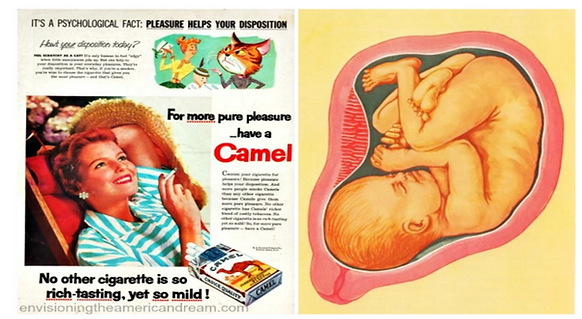
We will discuss the evolution of smoking from cure what what ails you to one of the most dangerous health risk. CNN Health did a great visual essay feature on the history of smoking. I've included some info from the article below. We will also discuss the resilience of the tobacco industry. Due to the proliferation of health information cigarette smoking is declining in the USA. Where is it rising?


The Social Determinants of Health
Social determinants of health (SDOH) are the nonmedical factors that influence health outcomes. They are the conditions in which people are born, grow, work, live, and age, and the wider set of forces and systems shaping the conditions of daily life. These forces and systems include economic policies and systems, development agendas, social norms, social policies, racism, climate change, and political systems. Centers for Disease Control and Prevention (CDC) has adopted this SDOH definition from the World Health Organization.
Donald Light (Light and Schuller 1986:9) explains, “medical care and health services are acts of political philosophy.” Thus, social and political values influence the choices made, institutions formed, and levels of funding provided for health. It is no accident that the United States has its particular form of health care delivery and other nations have their own approaches. Health is not simply a matter of biology but involves a number of factors that are cultural, political, economic, and social in nature.

Stress
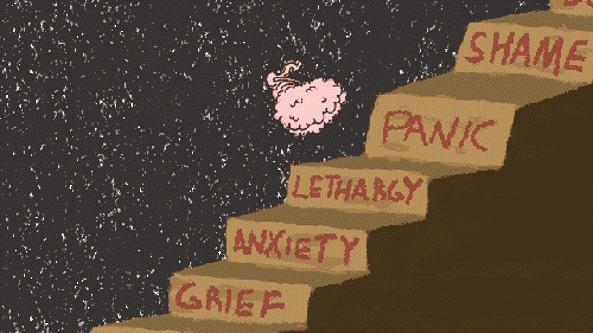
Social variables can also be a source of stress which can lead to poor health outcomes.
Social stress isn’t just about individual feelings, it’s a socially patterned experience shaped by inequality, institutions, culture, and relationships. Sociologists study stress as something produced by social structures, not simply personal weakness or biology.
How we choose to spend our money
There are many factors that go into ideas of health and healthcare. One major factor is how much we spend on health and health care.

I asked AI to give me the most current information on recent healthcare cuts.
Prompt: Please give me a short list of all of the health care cuts under Trump. Also list any proposed or future cuts outlined in the Big Beautiful Bill.
OBBBA stands for the One Big Beautiful Bill Act.
-
CMMI stands for the Center for Medicare and Medicaid Innovation.


If you are a Medical Sociologist you could be very busy in the next few years. Due to how we are spending our money we can expect, increased uninsured rates among low‑income and disabled populations, greater uncompensated‑care burden on hospitals, widening racial and geographic health disparities and reduced access to preventive and community‑based care.... overall sicker communities.


Mitch McConnell has not been seen in public since June 14. As of August 5, with the updating of this website, he is still missing. Would your job cover his type of health care? Could you just spend weeks in the hospital and not report to work? Taxpayers' money funds his salary should he be obligated to inform them of his ability to do the job he was elected to do? His case is the perfect example of health care disparities. He is not working, he is still getting paid, and he has the best health care money can buy.
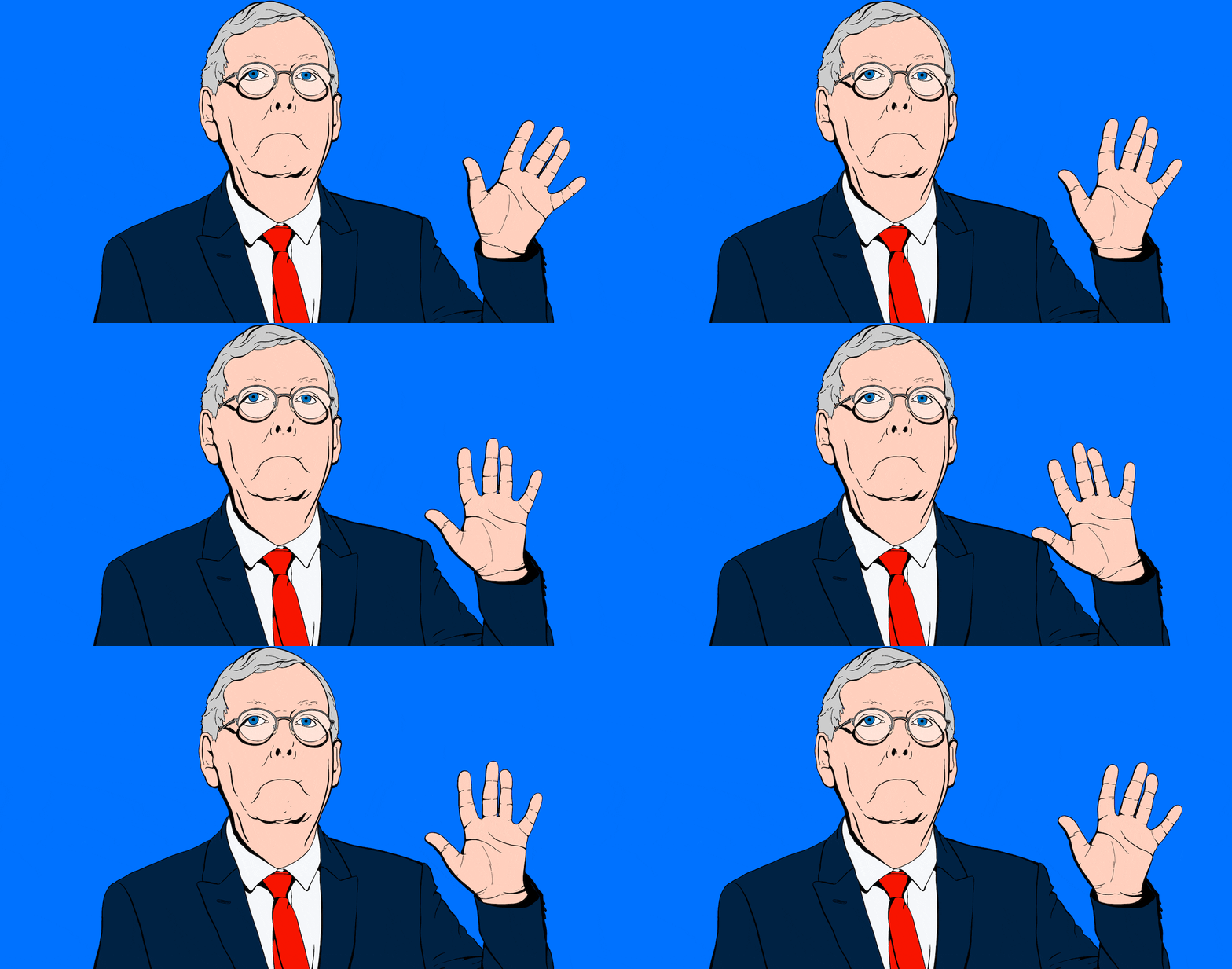
Trust Me Bro, I'm Alive!
Assignment Discussion Post
This is a very simple question with a very difficult answer.
Should health care be a human right?
If you are a citizen of earth, health care should be a basic human right.
On the discussion board make your case for your agreement or disagreement with this statement.
Do you agree or disagree with this statement give three reasons why or why not? Be specific.
(You can consider things like cost, morals, social behaviors, biology, technology and access. 400 words -100 points)
