
Squires Sociology
Your site navigation menu is at the bottom of each page.

Sociological Theory SA502
Topic #8 Phenomenology & Ethnomethodology
Phenomenology in sociology is the study of how people experience and interpret the world around them. It focuses on subjective meaning — how individuals make sense of everyday life rather than how society objectively functions.
-
People act based on their perceptions and meanings, not just external forces.
-
Reality is socially constructed through shared experiences and communication.
-
Sociologists using phenomenology try to understand the “lifeworld” — the world as people actually live and experience it.
-
Phenomenologists study the life‑world to uncover how social reality is constructed through everyday understanding. It forms the foundation for later theories like social constructionism and symbolic interactionism.
For example, when studying education, a phenomenologist might explore how students experience “success” or “failure”, rather than measuring grades alone.
Readings
-
Reading: Wallace and Wolf Chapter 5 Symbolic Interaction
-
Reading: Walace and Wolf Chapter 6
-
Reading: Wallace and Wolf Chapter 7
-
Goffman Summary: https://web.csulb.edu/~hmarlowe/SOC335/Goffman_Dramaturgical_Model.pdf

Phenomenology, according to Edmund Husserl, is the study of consciousness and lived experience. He was a philosoper and he argued that instead of analyzing the world through scientific or objective lenses, we should focus on how things appear to us — the way we experience them directly. Husserl’s method moves from suspending assumptions to revealing the essence of experience, then returns to the life‑world — the foundation of all meaning. It’s a disciplined way of studying how reality is constituted in consciousness.
For Husserl reality is not something “out there” independent of us; it is constituted through our perception and meaning‑making. By “bracketing” assumptions (a process called epoché), Husserl sought to uncover the essence of experience — the pure structures of consciousness that make understanding possible.
Phenomenology is Husserl’s method for exploring the world as it is lived, not merely observed.

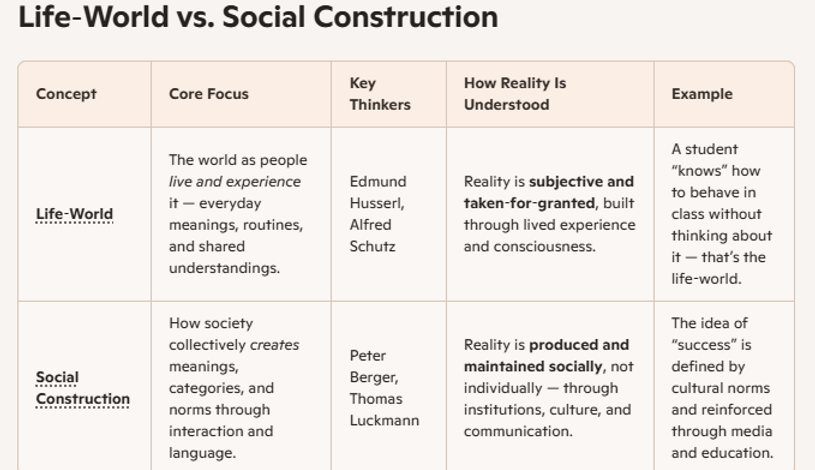
The term lifeworld was coined by Edmund Husserl (philosopher) and expanded by Alfred Schutz (sociologist), the life‑world refers to the realm of ordinary consciousness or how individuals perceive, interpret, and act within their social environment. It’s not the objective world of science, but the subjective world of meaning that people share through interaction. In phenomenology, the life‑world (Lebenswelt) is the world of everyday lived experience or the reality people inhabit before analyzing or theorizing it. It’s the taken‑for‑granted background that gives meaning to all social actions.
Schutz’s Life‑World Model
-
Subjective ExperienceThe individual’s personal consciousness — how one perceives and interprets reality.A teacher feels pride when students succeed.
-
IntersubjectivityShared meanings built through communication and interaction.Classroom norms like raising hands or group work.
-
Social TypificationPeople categorize others and situations using social “types.”Seeing someone as “student,” “colleague,” or “authority.”
-
Stock of KnowledgeThe accumulated common sense and cultural understanding guiding everyday life.Knowing how to greet someone or interpret politeness.
-
Taken‑for‑Granted RealityThe background world that feels natural and unquestioned.Assuming classrooms have teachers and students.
-
Concept Summary
-
Schutz’s model shows that the life‑world is layered — from personal experience to shared social meanings. It connects individual consciousness with collective social structures, explaining how people navigate society through everyday understanding.


Video
Ethnomethodology
-
Developed by Harold Garfinkel, building directly on Schutz’s ideas.
-
Studies the methods people use to make sense of everyday life — the “rules” and routines that sustain social order.
-
Focuses on practical reasoning and interactional norms rather than abstract consciousness.
-
Uses real‑world observation (like conversation analysis) to reveal how meaning is maintained in social interaction.
Phenomenology provides the philosophical lens, and ethnomethodology turns that lens toward real social practices — showing how people do social reality in daily life.
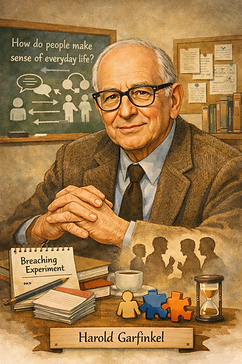

A breaching experiment is a sociological method developed by Harold Garfinkel to reveal the implicit social rules that organize everyday life.
A breaching experiment intentionally disrupts normal social expectations to observe how people react and restore order. It exposes the “taken‑for‑granted” norms that guide behavior but usually remain invisible. ChatGPT

Assignment
Conduct Your Own Breaching Experiment
Commit a Deviant Act - Break a simple folkway!
Command College and Criminal Justice students it is very important to understand why YOU think people become deviant. Why do 'criminals" commit crimes? Your answer to this question is going to have a great deal of impact on how you approach each situation.
Have some fun and see how hard it is for you to be deviant. Do not break any laws or do anything that could bring formal legal sanctions
For this assignment you must break a simple folkway and write up peoples reactions to your behavior. You must define folkway in your write up. Do not break any laws or activities that could bring you legal or formal sanctions. You will also get an F for the assignment.
Discussion Question
Discussion Question #5: Briefly tell the class about your act of deviance. How did you feel about breeching a social norm and how did people react to you? Would you do it again? Many in this class are in law enforcement how did it feel to be purposefully deviant? Do Not break any laws or do anything that could jeopardize your job or family. Those types of things are not simple folkways. Further do you think deviants are rational actors? Do you agree with the basic ideas of these theoretical perspectives? Do you think people make decisions about cost or rewards for all of their actions?

Critical Thinking - Review
Quick Links
