
Squires Sociology
Your site navigation menu is at the bottom of each page.

Sociological Theory SA502
Topic #5 Max Weber and Georg Simmel
This week we will examine one of the Weber and Simmel. Their work collectively shaped modern sociological methodology, emphasizing interpretation, interaction, and meaning.

We create meaning through these diverse interactions.
Late 19th Century — Foundations
-
Weber’s early work (1889–1896): Focused on economics and law; began exploring how values and meaning shape social action.
-
Simmel’s early essays (1880s–1890s): Developed formal sociology, studying recurring patterns of interaction (conflict, exchange, cooperation).
1900–1910 — Core Theoretical Contributions
-
Weber (1904–1905) — The Protestant Ethic and the Spirit of Capitalism: Connected religious ideas to the rise of modern rational capitalism.
-
Simmel (1900) — The Philosophy of Money: Examined how monetary exchange transforms social relationships and individuality.
-
Both emphasized subjective meaning and social forms, bridging philosophy and sociology.
1910–1920 — Mature Theory
-
Weber (1913–1920) — Developed Verstehen (interpretive sociology) and types of authority (traditional, charismatic, rational‑legal).
-
Simmel (1911–1918) — Wrote The Metropolis and Mental Life, analyzing how urban life affects identity and social distance.
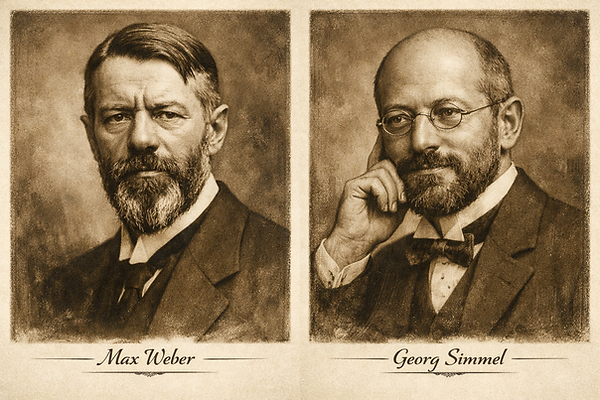

We will talk in detail about their contributions to the discipline. The info below are just a few of their key points.
Max Weber
Major Contributions:
-
Social action theory — Weber argued that sociology should focus on understanding the motives and meanings behind human behavior rather than just observing external patterns.
-
The Protestant Ethic and the Spirit of Capitalism — linked religious values to the development of modern capitalism.
-
Rationalization — described how modern societies become increasingly organized by efficiency, calculation, and control.
-
Authority typology — distinguished traditional, charismatic, and rational‑legal authority as forms of legitimate power.
-
Weber’s work bridged macro‑level institutions and micro‑level meaning, making him central to sociological theory and methodology.

Types of Authority: Traditional, Rational-Legal, and Charismatic
•Traditional authority: authority through compliance with well-established cultural practices (King)
•Rational-legal authority: legitimate because it is based on established laws, rules, and procedures (CEO)
•Charismatic authority: legitimacy derived from extraordinary personal characteristics of an individual leader, which inspire loyalty and devotion (Cult Leader)
Weber also expanded Marx idea of class and status. For Marx there were two classes. One had power the other did not. Weber noted that the social world is much more complicated. He said that status, and or power can come from many social arrangements.
Weber created a multifaceted social stratification theory that considers the interaction of power, prestige, and money.
For him the distribution of power within a society is influenced by factors such as class status and party.

Rationalization and Bureaucracy
Weber was looking at how society organized itself. The central theme in Weber's analysis of modern society was the process of Rationalization. He felt that rationalization was a far reaching process whereby traditional modes of thinking were being replaced by an ends/means analysis concerned with efficiency and formalized social control.
•Characteristics of Bureaucracy
•High degree of division of labor and specialization
•Hierarchy of authority
•Rules and regulations
•Impersonal relationships
•Career ladders – advancement becomes a career
•Efficiency – high coordination of activities

Weber also made a big contribution to the sociology of Religion. He noted that religions illustrate or reflect the type of society it exists in.
Weber argued that certain Protestant beliefs, especially those of Calvinism, unintentionally fostered the mindset that made capitalism thrive.

Another Major Concept – Verstehen or Understanding
•We must understand subjective meanings. To fully understand society
•Social status also important not just class – conflict had many roots
Verstehen refers to the process of interpreting social action by understanding the subjective meanings individuals attach to their behavior. Weber believed that sociology should not only describe what people do, but also grasp why they do it — the motives, intentions, and cultural context behind their actions.
What does Weber mean by Social Action?

Georg Simmel
Georg Simmel (1858–1918)
Classification: His research is often categorized as microsociology and formal sociology, focusing on patterns of interaction and the forms of social relationships.
Major Contributions:
-
Social forms — studied recurring patterns like conflict, exchange, and cooperation that structure social life.
-
The metropolis and mental life — analyzed how urban environments shape individuality and social distance.
-
Dyads and triads — explored how group size affects social dynamics and cohesion.
-
Philosophy of money — examined how monetary exchange transforms social relationships and values.
Simmel’s work laid the groundwork for symbolic interactionism and network theory, emphasizing how everyday interactions create social structure.

During this section we will also talk about the difference between Marx and Simmel's idea of money.
Simmel’s work taught sociologists to see society as a web of interactions, not just institutions or laws. He bridged philosophy and sociology, influencing thinkers like Mead, Goffman, and Bourdieu. His approach remains essential for understanding social networks, identity, and modern urban life.


Topic #5 Reading
-
Reading: W &W Chapter 4 pg. 183
-
Reading: Ritzer Chapter 4
-
Reading: Ritzer Chapter 5
Assignment
TBA