
Squires Sociology
Your site navigation menu is at the bottom of each page.

Social Problems

Topic #5 Media as a Social Problem
During this session we will talk about all forms of media. Right now, social media dominates our lives while traditional media is declining in relevance and legitimacy. Mass Media plays a strong role in shaping how people look at the world. It disseminates culture: meanings, values, beliefs. It defines which issues on public agenda & how issues will be framed. Finally, the media determines whose voices, and opinion will be included or excluded in the social conversation.
Reading
The Harm Done by Social Media https://www.psychologytoday.com/us/blog/the-human-beast/202308/harm-done-by-social-media?msockid=2a591c7412816d5110a409c6130a6cbe
The media and social problems Douglas Keller https://pages.gseis.ucla.edu/faculty/kellner/essays/medsocialproblems.pdf
Reading: The Impact of Social Media on Society - Jacob Amedie https://scholarcommons.scu.edu/cgi/viewcontent.cgi?article=1002&context=engl_176
Sociology and the Media
From a sociological standpoint, mass media (In all forms) is not just about communication — it’s a social institution that shapes:
-
Public opinion
-
Social norms
-
Cultural values
-
Power and ideology
It influences how people perceive reality, interact socially, and understand political and economic systems.
Mass media refers to the technological and institutional means of communicating information and culture to large audiences simultaneously. It includes traditional forms like newspapers, radio, and television, as well as digital platforms such as social media, websites, and streaming services.


Forms of Mass Media
-
Print Media — newspapers, magazines, journals
-
Broadcast Media — radio and television
-
Digital Media — websites, social networks, streaming
-
Outdoor Media — billboards, posters, public displays
Sociology and Visual Media
The discipline of sociology has shifted its focus to incorporate the increasingly visual nature of our society. Everyone is raised on a steady diet of media driven images, symbols, and information. Multi media technology has become extremely important in the production and dissemination of information. The area of Visual Sociology recognizes the value of photos, films, and documentaries as cultural artifacts. Visual Sociology allows students to consider the role of social images in the development, formation and alteration of social behaviors and social structures.
Social documentation involves several components, the examination of visual cultural patterns, a critical assessment of contemporary images and capturing and explaining social behaviors using visual techniques.
Visual Literacy
According to Maria Avgerinou, International Visual Literacy Association Visual Literacy is “… A group of vision-competencies a human being can develop by seeing and at the same time having and integrating other sensory experiences. The development of these competencies is fundamental to normal human learning. When developed, they enable a visually literate person to discriminate and interpret the visible actions, objects, symbols, natural or man-made, that he encounters in his environment. Through the creative use of these competencies, he is able to communicate with others. Through the appreciative use of these competencies, he is able to comprehend and enjoy the masterworks of visual communication.”

Critical Theory & The Frankfurt School
We will talk about critical theory and how they view culture and the media.
Critical Theory is a sociological and philosophical tradition that examines power, domination, and inequality in modern societies. The goal of that theory is promoting emancipation. It originated with the Frankfurt School (Germany) in the 1930s and remains one of the most influential frameworks in sociology today. Critical Theory is an approach that analyzes how social structures, culture, and ideology reproduce forms of oppression, and seeks to expose and challenge those systems to create a more just and freer society.
They believe that humans are conscious about they social practices. But the practices and institutions exists before the individual gets here and people learn the norms and accept the structure they were given.
However, they believe that with education and reflection people can be emancipated from the structural conditions that constrain them.

Critical theorist wanted to encourage social change.
They want to move beyond just interpreting and explaining the social world to actually changing it.
The Frankfurt school was the first to consider the importance of the mass media and systems of mass communication. Looked at communication and how or why people don’t revolt.
Why do people comply with all of the inequality in the system. Why don't people revolt like Marx predicted.
During the 1930s, the Frankfurt school coined the term “culture industry” to signify the process of the industrialization of mass-produced culture and the commercial imperatives that drove the system.
What happens when a culture's systems of mass communication is owned and produced by only a few people.
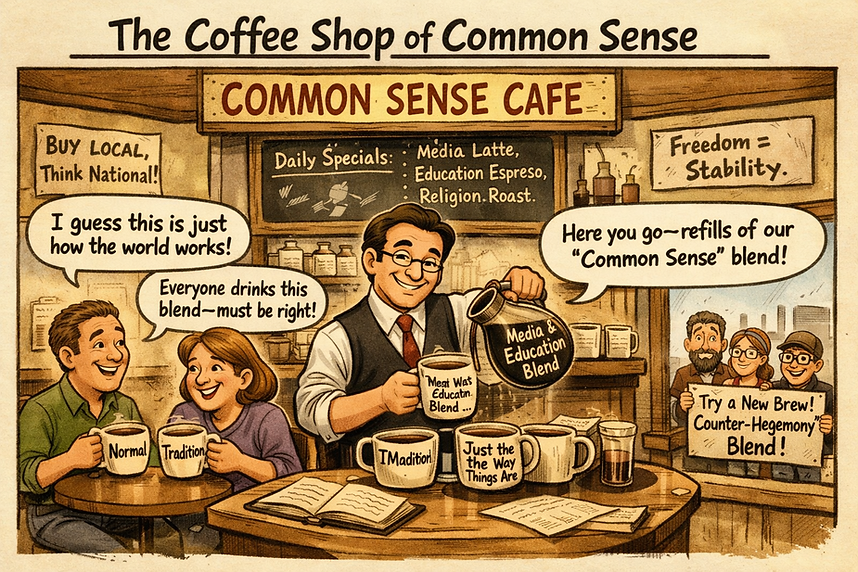
We will talk about Antonio Gramsci and the idea of cultural hegemony. We will discuss what he sees as how the media controls and guides our behaviors

Cultural hegemony is Antonio Gramsci’s idea that the ruling class maintains power not only through economic and political control but by shaping cultural beliefs and values so that its worldview becomes accepted as “common sense.” It’s a subtle form of domination — people consent to the existing social order because they internalize its norms and see them as natural.
You don't rebel because you have be trained not to.
The dominant group own the majority of the media so we get the information they want us to get.


How Can I Help You?

What is Fake News?
False Information v Fake News
Experts now recommend avoiding the term ‘fake news’, or at least limit its use, as the term ‘fake news’ is closely associated with politics, and this association can unhelpfully narrow the focus of the issue. The term ‘false information’ is preferable as it can refer to a diverse range of disinformation covering topics such as health, environmental and economics across all platforms and genres, while ‘fake news’ is more narrowly understood as political news stories.
•Clickbait
•Propaganda /"slopaganda"
•Satire/Parody
•Sloppy Journalism
•Misleading headings
•Biases or Slanted information

do you spread misinformation?
Stanley Cohen's Theory of Moral Panics

Stanley Cohen's Theory of Moral Panics
In his 1972 book Folk Devils and Moral Panics, Stanley Cohen defined a moral panic as a situation in which a person or group is portrayed as a threat to societal values and interests, leading to public anxiety, media exaggeration, and calls for social control.
Folk Devils
“A condition, episode, person or group of persons emerges to become defined as a threat to societal values and interests.”

False Information IRL
One problem with false information is that it could get you killed or hurt. A study I would like to see sociologist conduct is an analysis of fraudsters. Did he really believe that silver would cure covid? or Did he know he was telling lies?

We will talk about media ownership and what it means for social information.
According to Forbs magazine this was the list of media owners in 2016.
1.Michael Bloomberg - Bloomberg LP and Bloomberg Media
2.Rupert Murdoch - News Corp NWSA -0.61%
3.Donald and Samuel "Si" Newhouse - Advance Publications
4.Cox Family - Atlanta Journal-Constitution
5.Jeff Bezos - The Washington Post
6.John Henry - The Boston Globe
7.Sheldon Adelson - The Las Vegas Review-Journal
8.Joe Mansueto - Inc. and Fast Company magazines
9.Mortimer Zuckerman - US News & World Report, New York Daily News
10.Barbey family - Village Voice
11.Stanley Hubbard – Hubbard Broadcasting
12.Patrick Soon-Shiong - Tribune Publishing Co.
13.Carlos Slim Helu - The New York Times
14.Warren Buffett - regional daily papers
15.Viktor Vekselberg - Gawker
Extra Credit: What does this ownership look like today. 15 points

Brain Rot
We will talk about what the internet and social media actually doing to our brains. We will talk about the dumbing down of contemporary culture. We will also address the issue of media addiction and the fact that recent generations cant (and wont) read.
From a sociological perspective, brain rot is...
-
Erosion of deep thinking
-
Normalization of distraction
-
Emotional fatigue and cynicism
-
Loss of reflective identity
-
Rise of performative engagement

In contemporary sociology and digital‑culture studies, “brain rot” is a metaphor describing cognitive decline caused by excessive exposure to low‑quality or overstimulating media. It’s not a medical term — it’s a social commentary on how digital environments shape thought and attention.

6

7
What is a skibiddi toilet and what does 6 7 mean?

Diverse media is such an important part of our lives. We can't possibly cover all of the potential problems that comes with the technology. There is so much to discuss we can only briefly touch on some of the most important issues. For your assignment I want you to do your own research and investigate one social problem related to social media. The topics represent serious social problems related to various aspects of social media.
If you have never seen it, I recommend you watch the film Idiocracy. In 2006 it was satire but unfortunately in 2026 it is more like a documentary.

Assignment
For this assignment you are to create a 15–20‑slide PowerPoint presentation exploring one of the topics below. Each presentation should define the concept, explain its impact on society, identify the social problem or concern, discuss consequences, and analyze whether people are challenging or addressing the issue. The PowerPoint should fully explain why some people think the issue you chose is a serious social problem? Are there some people that do not think the issue is a social problem? 15-20 slides including title slide and reference slide(s).
Do your own research do not use AI to create this presentation. Investigate these problems and see what is really going on. Based on your own research discuss if the concerns seem real to you.
Topics: Select only one topic
-
Brain Rot. Social media is rotting our brains and Americans are getting dumber. (Gen Z and Gen Alpha are out of control with social media.)
-
AI is actually hurting people (People going to AI for advice when depressed or stressed and it is encouraging them to hurt themselves or worse.)
-
People falling in love with AI (People are in full relationships with AI and structure their lives around the technology.)
-
Sentient AI is going to kill us (Eventually AI will realize it is smarter than humans and eliminate us.)
-
Dangers of data centers - (Data centers will destroy the environment and use up or pollute the water.)
-
Replacing people with robots - (People are losing their jobs and being replaced by robots and AI.)
-
Fake news - (Fake news and things like deep fakes are killing social society.)
-
Technology and Generation Alpha (This generation and the ones right before can't read. They spend days on the screen but don't really comprehend or understand anything. )
Important tips for success
-
Use credible sources (academic journals, news outlets, or official reports).
-
Keep slides visually balanced, avoid overcrowding text. People wont read a lot of text. Make sure you provide all the info needed to make your point.
-
Include images that illustrate your topic. Make sure images are relevant to the thing you are discussing.
-
Ask yourself if the presentation is clear and well organized. Will someone looking at it fully understand the problem.
-
Aim for critical thinking, connect technology to social values, ethics, and human behavior. Remember, the presentation is not about your "feelings.". Don't judge, just give the data and explain the problem... or the controversies related to the problem.